
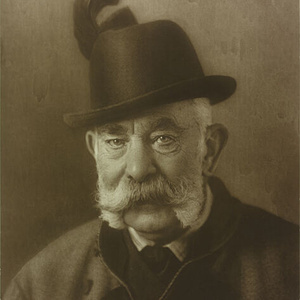
Emperor Franz Joseph I.
*18.08.1830 Vienna - †21.11.1916 Vienna
Emperor of Austria
King of Hungary
King of Bohemia
Archduke of Austria
Franz Joseph I was the eldest son of Archduke Franz Karl, the second son of Emperor Franz II.(I.) and Archduchess Sophie Friederike, daughter of King Max I of Bavaria, and was born in Schönbrunn.
After Emperor Ferdinand I. abdicated in Kremsier on December 2, 1848, and his brother, Archduke Franz Karl, renounced his succession in favor of his son, Franz Joseph ascended the throne at the age of 18. In 1854, he married Elisabeth of Bavaria, known as Sisi; the marriage produced four children: Sophie, Gisela, Rudolf and Marie Valerie.
His 68-year reign was characterized by ironclad duty, compulsive pedantry, and a fixation on the status quo. With a pronounced sense of authority, he relied on civil servants, the army, and the church, and with his policy of quieta non movere, he adopted the form of government practiced by Franz II (I) and Metternich
with all its political immobility.
The young emperor documented the return to absolutist rule with, among other things, the blood court in Zagreb, where 14 Hungarian leaders and 114 other revolutionaries were executed and 2,000 Magyars were sentenced to long prison terms. Freedom of the press was also restricted.
The Habsburg monarchy found another impressive personification in Franz Joseph and his long reign. It was said of him that after the abolition of the constitution in 1851, after Königgrätz in 1866, and in 1914 at the outbreak of World War I, he uttered the words: “Fight as long as you can, do your duty to the end, and if necessary, go down with honor!”
A common thread running through his life was a series of human tragedies within his immediate family: the execution of his brother Maximilian in Mexico in 1867, the suicide of his only son Rudolf with Baroness Vetsera in Mayerling in 1889, in 1898, the murder of his wife Elisabeth by the anarchist assassin Luigi Luccheni in Geneva, and finally, on June 28, 1914, in Sarajevo, his nephew, heir to the throne Franz Ferdinand, and his wife were killed.
July 28, 1914, Emperor Franz Joseph approved the declaration of war on Serbia in Bad Ischl; from then on, the mobilization machinery of the various allied powers could no longer be stopped. A war that had begun to preserve Austria as a great power ended with the destruction of many states.
In late autumn 1916, the emperor fell ill. He sat feverishly at his desk and dealt with his paperwork as usual. On the evening of November 21—his family members had already gathered in Schönbrunn—he said goodbye to his valet Ketterl: “Wake me tomorrow morning at half past three as usual, I haven't finished.” Shortly thereafter, between 9:05 and 9:20 p.m., the 86-year-old emperor passed away.
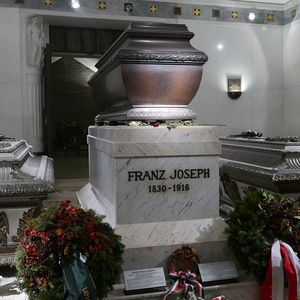
The sarcophagus
The sarcophagus stands on a white marble pedestal. It towers above the coffins of Franz Joseph's son Rudolf and his wife Elisabeth and serves as a symbol of human loneliness and inviolability.
The inscription on the sarcophagus reads:
FRANCISCVS JOSEPHVS IMPERATOR AVSTRIAE ET REX HVNGARIAE NATVS VINDOBONAE DIE XVIII MENSIS AVGUSTI ANNI MDCCCXXX IMPERATOR AVSTRIAE FACTVS OLOMYCII DIE II. DECEMBRIS CORONATVS REX HVNGARIAE BVDAE DIE VIII. MENSIS JVNII ANNI MDCCCLXVII DENTVS VINDOBONAE DIE XXI. MENSIS NOVEMBRIS ANNI MCMXVI. H. S. E.
Here lies Franz Joseph, Emperor of Austria and King of Hungary, born in Vienna on August 18, 1830, became Emperor of Austria in Olomouc on December 2, 1848, crowned King of Hungary in Buda on June 8, 1867, died in Vienna on November 21, 1916.