
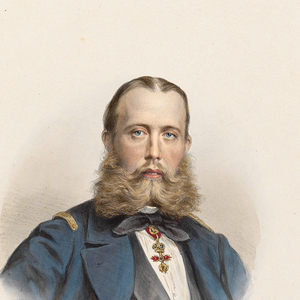
Emperor Maximilian of Mexico
*06.07.1832 Vienna - †19.06.1867 Querétaro, Mexico
Emperor of Mexico
Archduke of Austria
Maximilian, the son of Archduke Franz Karl and Sophie Friederike of Wittelsbach, was a brother of Emperor Franz Joseph. He became rear admiral of the Austrian Navy and governor-general of the Lombardy-Venetia Kingdom from 1857 to 1859.
Due to French interests, he became Emperor of Mexico in 1864, supported by Napoleon III and encouraged by conservative circles in Mexico. Poorly advised, without support, and abandoned by France, Maximilian, a liberal thinker with an interest in science, was unable to quell the unrest in the country. Revolutionaries under the command of Benito Juarez, a Mexican lawyer of Native American descent, first besieged him in the fortress of Querétaro in the highlands of Mexico and finally captured him.
On June 19, 1867, Maximilian was shot together with his loyal followers, Generals Miguel Miramon and Thomas Mejia, as a symbol of the victory of the Mexican independence movement over the interests of European imperialism.
Shortly before his execution at Cerro de las Campañas, Maximilian allegedly had La Paloma played for him in accordance with an old Mexican tradition. He gave each of the soldiers of the firing squad an ounce of gold and asked them to aim at his chest so that the first volley would kill him. “Long live Mexico, long live independence,” he shouted before dying after the third volley.
His body was brought to Trieste by Admiral Freiherr von Tegetthoff on the Novara, his first command ship, with which he had landed in Vera Cruz in 1864, and was buried in the Imperial Crypt on January 18, 1868, after being posthumously awarded the title of Archduke of Austria once again.
Cölestin Wolfsgruber, an eyewitness to the funeral, reported that wreaths were laid out on black velvet cushions. At the head was a silver laurel wreath dedicated by Charlotte, his unfortunate wife. Three ribbons with inscriptions were attached to a silver laurel wreath with a silver ribbon, dedicated by Emperor Franz Joseph: “To the true Christian” – “To the unforgettable brother” – “To the noble hero.”
A silver laurel wreath with the list of dedications from Mexican noblemen also lay on Maximilian's coffin:
A LA MEMORIA AUGUSTA
DE S. M. EL EMPERADOR MAXIMILIANO
MUERTO POR MEXICO EL 19 DE IUNIO DE 1867
CONSAGRAN
REVERENTES, ACRADECIDOS
DONA MA ANA PEON DE REGIL
DONA LOVETO PEON Y PEON
DONA JOAQUINA PEON Y PEON
DON PEDRO DE REGIL Y PEON
DON ALONSO L. PEON DE REGIL
DON PEDRO M. PEON DE REGIL
DON ALVARO PEON DE REGIL
DON AUGUSTO PEON Y PEON
DON JOSÉ MA PEON Y LOZA
DON RAFAEL PEON Y LOZA
DE YUCATAN
In a poem written by Maximilian, he states:
I do not wish to perish in the valley,
my last view restricted by constraint:
I wish to die on a mountain,
At a golden sunset.
During his imprisonment, Maximilian was convinced that his wife Charlotte had died. In his will, he stipulated that his wife should be buried next to him in the Imperial Crypt.
Charlotte, who had gone mad, did not die until 1927 at Bouchout Castle and was buried in the church at Laeken.
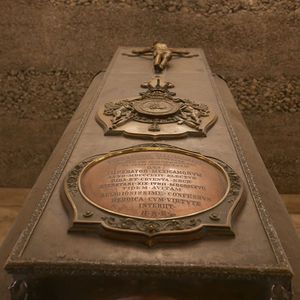
The sarcophagus
The simple copper coffin is slightly curved, stands on six feet, and has gilded ornaments. On the lid is a cross with a corpus, gilded bronze. Beneath it is the coat of arms of Mexico with a crown and the inscription plaque. The sarcophagus was made by the imperial and royal coppersmith Oberst.
The inscription on the sarcophagus reads:
FERDINANDVS. MAXIMILIANVS ARCHIDVX. AVSTRIAE NATVS. IN. SCHOENBRVNN VI. IVLII. MDCCCXXXII QVI IMPERATOR. MEXICANORVM ANNO. MDCCCLXV. ELECTVS DIRA. ET CRVENTA. NECE QVERETARI. XIX. IUNII. MDCCCLXVII FIDEM. AVITAM RELIGIOSISSIME. CONFESSVS HEROICA. CVM VIRTVTE INTERIIT. H. S. E.
Here lies Ferdinand Maximilian, Archduke of Austria, born in Schönbrunn on July 6, 1832, elected Emperor of Mexico in 1865, who died in Querétaro on June 19, 1867, after professing his ancestral faith with piety and heroism, the victim of a cruel and bloody murder.