
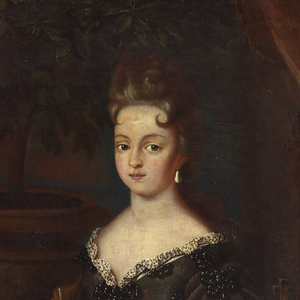
Empress Amalia Wilhelmina
*21.04.1673 Lüneburg, Germany - †10.04.1742 Vienna
Empress of the Holy Roman Empire
Queen of Hungary
Queen of Bohemia
Amalia Wilhelmina was the daughter of Duke Johann Friedrich of Brunswick-Lüneburg and was married to Emperor Joseph I. by proxy in Modena on January 15 and in person in Vienna on February 24, 1699. Before her marriage, she converted from Protestantism to Catholicism and changed her name from Wilhelmina Amalia to Amalia Wilhelmina.
After the death of Emperor Joseph I (1711), she lived with her two daughters, Maria Josepha and Maria Amalia, in Schönbrunn Palace, which was assigned to her as her widow's residence, and in winter in that part of the Hofburg Palace which was named Amalienburg after her.
In 1716, she summoned the nuns of St. Francis de Sales from the Netherlands to Vienna and bought them the house of Baron von Quarient on Rennweg. On the day of the birth of the future Empress Maria Theresia – May 13, 1717 – she laid the foundation stone for the convent building, which was completed in 1719. Amalia Wilhelmina reserved an apartment for herself in the convent without, however, retiring there completely.
Her marriage to Emperor Joseph I produced three children: Leopold Joseph (1700-1701), Maria Amalia (1701-1756; she married Karl Albrecht of Bavaria in 1722, who contested the legality of the Pragmatic Sanction) and Maria Josepha (1699-1755; she married August II/III, Elector of Saxony and King of Poland, in 1719).
When her sons-in-law intervened in the War of Succession against Austria, Amalia Wilhelmina retired to a convent, where she died at the age of 69.
In accordance with her own wishes, only her heart was removed from her body and buried in a heart urn in the Imperial Crypt next to her husband's coffin.
Her body rests under the high altar of the Salesian church.
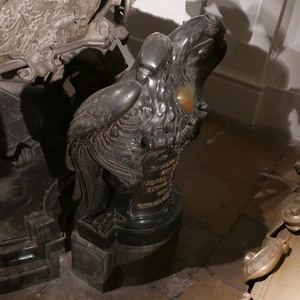
The heart urn
The heart urn is shaped like a double-headed eagle made of black marble. The heart capsule lies on the eagle's chest; it was originally made of gold and was later replaced by brass.
The inscription on a low pedestal in raised gold letters reads:
AMALIA. WILH. AUG. COR SUUM AD. PED. JOSEPH. IMP. A. CONIUG. DULCISS. REP. IUSS. XIV. AP. CICI-CCXLII
Amalia Wilhelmina, Empress, had her heart laid at the feet of Emperor Joseph of Austria, her beloved husband, on April 14, 1742.